

You may be wondering how the classes and academics are laid out here at the University of Limerick (UL). Let me highlight the classroom culture, course structure, teaching style, and course workload. First of all, some terminology! A singular particular class or course is called a module. And if someone asks what course you are in, they would be asking your major or programme focus, such as education, engineering, political science, etc.
Classroom Culture
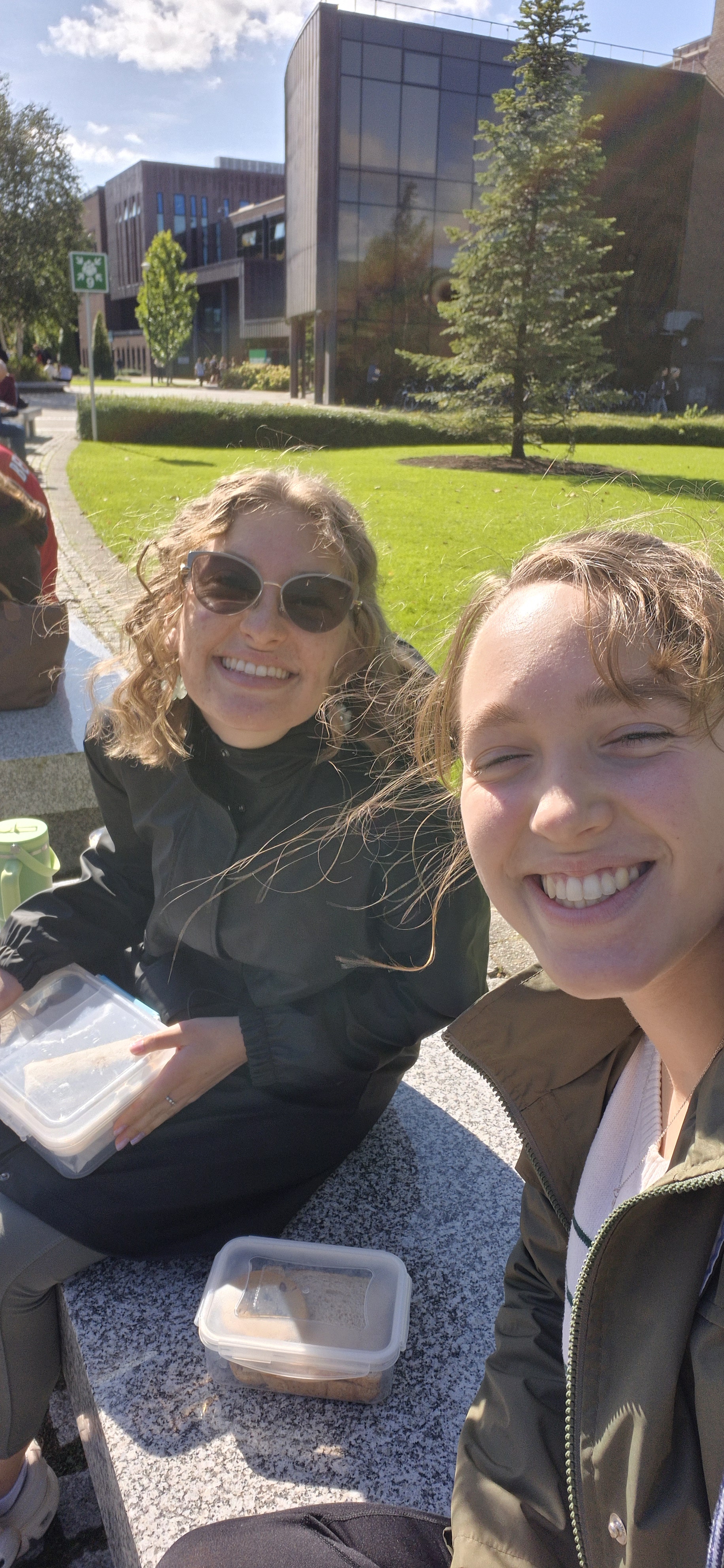
At UL, modules are filled with 18-22-year-olds who like to get distracted or doze off in class. I think that’s pretty typical for any college student. 🙂 Just like in the States, students are expected to attend every scheduled class period held, actively listen to the professor, and take notes for further study. In the first few weeks of school, they are very considerate of students walking in late because they could not find the lecture hall or classroom. It is a big campus with over 18,000 students and over 1,000 faculty and staff. This may be similar to your home university, but for me, this was vastly different from my small college in Minnesota, where the student body is around 700 students—that’s basically half the international student population at UL!
The main building on campus, composed of 5 sub buildings, is the most confusing building I have ever seen. It is practically a maze. With so many hallways, corners, and doors (oh my!), you’ve got to be extra careful to read the minimal signage as you venture into the unknown. But not to worry, not every class is held in this building. Thankfully, I have one class in the building, and it is literally 50ft inside the main entrance. I suggest finding a friend and walking the campus to find each lecture hall or classroom on your schedule in the days prior to the modules beginning. I did this my one of my housemates. Once we allowed ourselves the time (a whole afternoon) and space to be okay with potentially getting lost, we found it wasn’t as difficult as expected. It is important to note that in the States, the first floor is always the ground floor, but here, the ground floor is floor 0. The typical 2nd floor in the States is floor 1 here. Also, never be afraid to ask for help or directions! Everyone is so nice and more than willing to help if this makes you anxious.

Course Structure
The courses and modules are, in a way, similar, but there are some minimal differences. The modules are structured on different schedules than at home. At my home college, class times are fairly consistent and regular throughout the week. At UL, it’s broken down differently. Every course has a two-hour lecture time slot. These two hours may be back-to-back or split into two one-hour lectures and potentially be at two different times a week. For example, for my education module, I have a one-hour lecture on Wednesdays in the morning, and the other is on Friday in the afternoon. Traditionally in the States, both these lectures would be either at 9 am or at 3 pm, not two different times.
In addition to the lectures for each module, most also have a lab period or tutorial. These labs and tutorials are extra (but still mandatory) class periods designed to give students a chance to interact with and ask questions about the material from the lectures. Every student in the module attends the same lecture(s), most likely in theater seating. Students are divided up for labs and tutorials into groups of about 20-30. Traditional UL students are assigned to one of the multiple labs and tutorials to attend each week at the same time. Me, a study abroad student? I get to pick which one I want for the whole semester because I have to put my schedule together on my own. Traditional students are handed their schedules already put together. The semester is 12 weeks of classes, plus an additional 3 weeks for studying and taking the exams.
Teaching Style
The teaching style at UL is fairly similar to the States. Most professors put up a slide show and talk through it as students take notes and write down key points. For most modules, these slideshows are posted on the digital learning platform Brightspace, where students can reference them later. One of my professors does not use a PowerPoint, but instead just talks to the students. I’m still trying to figure this one out. The labs and tutorials are the smaller size discussion portion of the course.
Although I have not quite experienced this yet, I have been told that it is typical for students to address their professors on a first-name basis once initial introductions have been made. Professors are very eager to learn all their students’ names. It is also normal for a student to just speak during a pause in speaking if they have a question. They are not typically expected to raise their hand, and if they are, the professor will specify. I still raise my hand to answer questions—it’s a habit. 🙂
Workload & Study Habits
Weekly assignments vary based on each module and the professor. For example, my history module has two papers. One is due in Week 8 and the other in Week 12. Those are the only assignments. My education module, however, has weekly journal entries. These are not submitted each week, but students are expected to keep the journal up-to-date and submit it at the end of week 12. Other classes may have weekly readings or smaller projects every other week. For example, in my digital media module, we just had a small project where we were tasked to capture and edit a few photos on the theme of time. I don’t have a set homework schedule, as it varies from week to week, and my weekends might be filled with travel adventures. Some modules more heavily lean towards being independent study-led, and others have more guided instruction. Honestly, it just depends on the professor and the course content.

Overall, I cannot really say UL’s academics are more similar or more different from my experiences in the States. It truly depends on your courses and professors. My education module feels very familiar and easy to follow. I believe it’s mostly because of the content, but also the professor’s teaching style. My Irish history module feels much less familiar, and I’m still learning to navigate it. I find myself with more time than I usually would in a typical semester at home. Professors are always willing to help you adapt and answer your questions. In the end, experiencing a variety of teaching styles stretches our brains and increases our ability to receive and process different types of information. I hope this gives you helpful insight into UL as you continue to decide and plan your potential study abroad experience at UL!






 Study Ireland - Stories & Guides from International Students
Leave a comment